


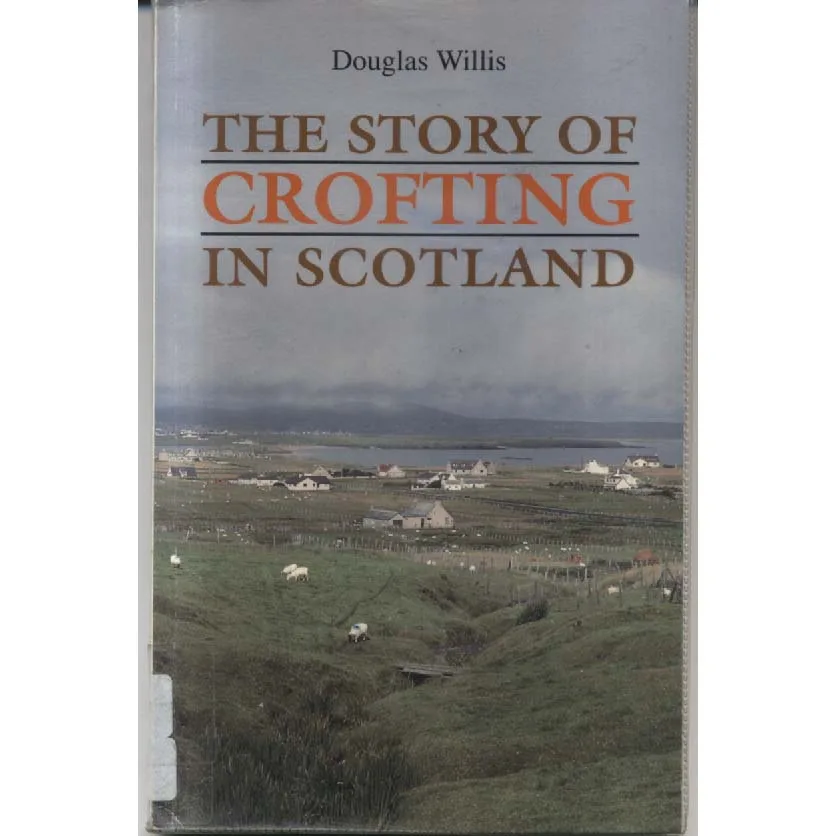
The Story Of Crofting In Scotland
Publisher: John Donald Publishers
Format: Paperback
ISBN: 9780859763448
The Story of Crofting in Scotland (1991) by Douglas Willis
John Donald Publishers | ISBN: 9780859763448
Condition: Good (Ex-Library)
As sold by Crappy Old Books
If you’ve ever looked at a windswept Scottish landscape and thought, “How on earth did anyone make a living out of this?”, congratulations — you’re already halfway into The Story of Crofting in Scotland. This is the book that answers that question with admirable calm, a deep sense of history, and the unspoken assumption that yes, of course people did it… while being rained on horizontally.
Crofting, for the uninitiated, is not “cute rural cottagecore with a tasteful cardigan.” It is a whole system of land, labour, rights, pressure, politics, community, and sheer stubborn endurance. It’s about small holdings, hard ground, big weather, and the kind of practical ingenuity that looks simple until you try it and immediately realise you’ve underestimated both the land and the people.
Douglas Willis tells the story of crofting in a way that’s grounded and human — the social history behind the scenery. This isn’t Scotland as a postcard; it’s Scotland as lived reality: land held in tight, complex arrangements, shaped by centuries of change, argument, reform, and survival. Crofting sits right at the intersection of livelihood and identity, and the book charts how it developed, how it was challenged, and how it persisted through economic shifts and political storms that make modern property disputes look like polite tea-time grumbles.
You’ll find crofting’s big themes here: land use, tenure, community, and the constant negotiation between what people need and what systems allow. It’s also a story of adaptation — not just to landscape, but to laws, landlords, markets, and the strange idea that “progress” sometimes arrives looking suspiciously like disruption.
And it’s a quietly fascinating read even if your closest brush with agriculture is buying a bag of tatties and feeling morally superior about it. Because crofting is not simply farming; it’s a social arrangement with history baked into it. The kind of thing that shapes settlement patterns, culture, and the everyday texture of life. It’s also one of those subjects that starts out sounding niche and ends up feeling like a key to understanding Scotland itself.
Now let’s address the copy: Ex-library. Which is frankly perfect. A book about crofting should come with a bit of institutional wear — a few stamps, maybe a label, the faint aura of being borrowed by someone who genuinely meant to return it on time. Ex-library copies are like working tools: they’ve been out in the world, they’ve done their shift, and they’ve come back with a few scuffs and stories. Consider it authentic patina, not damage.
Condition is Good, meaning it’s still solid and readable — ready to be adopted by anyone who likes their history practical, their landscapes uncompromising, and their human stories quietly heroic.
From Crappy Old Books: because not all Scottish history involves castles and battles. Some of it involves peat, policy, persistence — and the noble art of making a life where common sense would have packed up and moved south.
Keep browsing: See more History books Other books by Douglas Willis
